Lunio Alternatives: 6 Tools Compared, With Real Prices
Lunio doesn't publish a price. All six tools below do, and every one of them lets you pay month to month. Here is what each costs and what it protects.
✓ Free plan with no card · Paid plans from $39/month · Monthly billing
Last updated · Reviewed by the Didva team
If you want a Lunio alternative with a price you can see before a sales call, the short list is Didva, ClickCease, ClickGUARD, Fraud Blocker, TrafficGuard and Spider AF. Lunio itself is a strong multi-channel product. What sends people looking elsewhere is usually the buying model: a quote tied to a share of your ad spend, billed in pounds, on a 12-month term that renews unless you give 90 days' notice.
Stay with Lunio if a big share of your spend runs on TikTok, LinkedIn, X or Reddit, because none of the cheaper tools here covers all of those. If your budget sits mostly in Google Ads, a flat monthly plan does the core job for a lot less paperwork. Didva starts free and is $39 a month after that. If you also need Meta blocked inside the ad account, Fraud Blocker ($79 a month) is the cheapest published option, and ClickGUARD covers Google, Microsoft and Meta together from $149.
Lunio is the renamed PPC Protect. The history, and how to read reviews split across both names, is on the PPC Protect page.
Lunio and six alternatives, side by side
Prices and terms from each vendor's own website, checked 30 September 2026. Lunio and ClickCease were re-checked on 26 October 2026. Didva is our product.
| Tool | Price from | Pricing model | Free plan | Free trial | Contract | Google Ads | Microsoft Ads | Meta | Best for |
|---|---|---|---|---|---|---|---|---|---|
| Didva Our product | $39/mo | Flat tiers by clicks | Yes, 3,000 clicks/mo, no card | 14 days of Growth, no card | Monthly, cancel any time | Automatic IP exclusions, account-wide (Performance Max included) | Detects and scores; paste-ready exclusion list (paid plans) | Detects tagged ad clicks; Cloudflare blocking on Growth plan | Small and mid-size Google Ads accounts that want a published price |
| Lunio | Not published (quote) | Share of ad spend | No | 14-day audit via demo, run beside your current tool | 12 months, auto-renews (default terms) | Automatic IP and audience exclusions | Supported | Supported | Spend of $1M+ a year across many channels (Lunio's own fit) |
| ClickCease | $99/mo ($84 billed yearly) | Tiers by website traffic | No | 7 days, card required | Monthly or yearly; cancel before the next billing date, no partial refunds | Automatic IP exclusions | Listed (its pages differ on blocking) | Audience exclusions | Small sites wanting ad and bot protection in one bundle |
| ClickGUARD | $89/mo ($74 billed yearly) | Tiers by ad spend (entry plan: one platform) | No | 7 days, card pre-authorized | Monthly, quarterly or yearly | Automatic, incl. Performance Max | IP blocking | Supported | Hands-on control of exclusion rules |
| Fraud Blocker | $79/mo ($63 billed yearly) | Tiers by ad clicks | No | 7 days, card required | Month to month | Automatic IP exclusions | Manual IP export only | Automatic | A low published price for Google and Meta |
| TrafficGuard | $49/mo promo (up to $30k spend) | Flat under a spend cap, custom above | No | 30 days, card required, detection only | Monthly, cancel any time (Shield) | Search on Shield; PMax on Scale | Not publicly available | Custom plans, website-conversion campaigns | Multi-channel spend including mobile app installs |
| Spider AF | $150/mo ($120 billed yearly) | Flat tiers by clicks, no spend fees | No | 14 days, detection only, no card | Monthly or annual | Automatic (IPs, placements, audiences) | Supported | Exclusion audiences | Placement control without spend-based fees |
Didva Our product
Our product, so weigh this accordingly. Didva is the only tool here with a free plan that doesn't expire: 3,000 clicks a month, no card. Paid plans add automatic IP exclusions to your Google Ads account list, which Google applies to Performance Max as well, and blocking through Cloudflare if you use it. On Microsoft Ads we score the clicks and paid plans get a paste-ready exclusion list; nothing is pushed there automatically. Choose it for a Google-first account that wants a fixed price.
From $39/mo · Flat tiers by clicks · Trial: 14 days of Growth, no card
Lunio
The broadest channel list in this group, and its pricing page says an invalid IP found in one campaign or platform is excluded across the others automatically. In its own comparison with ClickCease, published 23 October 2026, Lunio puts its best fit at $1M or more a year across ten or more channels. The trade-offs are in the buying process: no public price, a 14-day audit that starts with a demo, and default terms of 12 months billed annually in advance.
From Not published (quote) · Share of ad spend · Trial: 14-day audit via demo, run beside your current tool · Lunio pricing , checked 26 October 2026
ClickCease
Owned by CHEQ and sold as its self-serve product. $99 a month on the monthly plan or $84 billed yearly, and new customers are offered 30% off their first three months on at least some plans. The trial is 7 days and asks for a card up front. It covers Google, Meta and Microsoft, and bundles WordPress bot blocking.
From $99/mo ($84 billed yearly) · Tiers by website traffic · Trial: 7 days, card required · ClickCease pricing , checked 9 November 2026
ClickGUARD
The one to pick if you want to tune the rules yourself, with exclusions by IP range, VPN, location, behavior and placement. Prices climb with ad spend rather than clicks. Watch the entry tier, which protects only one platform; Google, Microsoft and Meta together start on Standard, from $149 a month.
From $89/mo ($74 billed yearly) · Tiers by ad spend (entry plan: one platform) · Trial: 7 days, card pre-authorized · ClickGUARD pricing , checked 30 September 2026
Fraud Blocker
The cheapest paid option here that blocks on both Google and Meta, at $79 a month or $63 billed yearly for 5,000 ad clicks. Microsoft is export-only. When you hit your click limit, protection stops until you upgrade, so size the plan with some headroom.
From $79/mo ($63 billed yearly) · Tiers by ad clicks · Trial: 7 days, card required · Fraud Blocker pricing , checked 30 September 2026
TrafficGuard
The closest match to Lunio's breadth, and the only one here that handles mobile app install fraud through AppsFlyer, Adjust, Kochava and TUNE. The $49 Shield plan covers Google Search up to $30,000 a month in spend. Meta, Performance Max and anything above that cap move to a custom quote, which puts you back in a sales conversation.
From $49/mo promo (up to $30k spend) · Flat under a spend cap, custom above · Trial: 30 days, card required, detection only · TrafficGuard pricing , checked 30 September 2026
Spider AF
Flat pricing with no spend-based fees, and on Google it excludes placements and audiences as well as IPs. The entry plan is $150 a month, which is steep for a small account but predictable for a larger one.
From $150/mo ($120 billed yearly) · Flat tiers by clicks, no spend fees · Trial: 14 days, detection only, no card · Spider AF pricing , checked 30 September 2026
- Watchtower Free
3,000 clicks/month · Detection, manual blocking, 7 days of data
- Starter $39 /mo
20,000 clicks/month · Automatic blocking, exports, daily reports
- Growth $89 /mo
100,000 clicks/month · Everything in Starter plus appeal packs
Monthly billing, cancel any time. New accounts get 14 days of Growth free, no card. Full pricing
Start free, no cardWhy advertisers look for a Lunio alternative
Most people who search for this are not unhappy with Lunio's detection. They're stuck on how it's sold. There is no price on the website, so the first step is a form and a demo. The quote is a share of your ad spend, which means your bill rises every time your budget does, even if the amount of fraud doesn't.
Then there's the contract. Lunio's global terms set a 12-month initial term when the order form names no other, renew it automatically for another 12 months, and require written notice at least 90 days before the renewal date. Fees are billed annually in advance, in GBP. An individual order can change all of that, so read yours. If you only find out about the notice period in month eleven, you've already bought another year.
Choose Lunio if
- A real share of your budget runs on TikTok, LinkedIn, X, Reddit, Yandex or Naver. Lunio lists all of them, and none of the cheaper tools here does.
- You want one exclusion list pushed across every ad platform at once.
- You're comfortable buying on an annual contract.
Choose Didva if
- Most of your spend is in Search, Display or Shopping campaigns on Google Ads, and you want automatic IP exclusions there for a fixed $39 a month.
- You'd like to watch your own invalid traffic for a few weeks before paying anything. The free plan covers 3,000 clicks a month and has no end date.
- You want monthly billing with no notice period.
Be clear about what you'd give up. Didva scores Microsoft Ads clicks but doesn't push exclusions into Microsoft Ads; you paste the list in yourself (our Microsoft Ads click fraud guide covers that platform's 100-address limit). On Meta, Didva counts a click only when the ad's link is tagged as paid traffic, and it can only turn those visitors away at your website through Cloudflare, on the Growth plan and up. Meta still charges for the click.
Lunio's 14-day audit next to Didva's 14-day trial
On 23 October 2026 Lunio published a comparison with ClickCease that doubles as a switching offer. ClickCease customers can run a free 14-day Lunio audit while their current protection stays on, and Lunio then drafts a migration plan around data retention, switchover timing and the exclusions already in the account. It's a sensible way to sell to a big account. You still book a demo to start, the price still comes after the audit, and the contract that follows is annual unless your order form says otherwise.
Didva's version needs no call. A new account gets 14 days of the Growth plan with no card, and when the trial ends it falls back to the free plan rather than billing you. To test it against Lunio:
- Leave Lunio's cross-platform exclusions running. A new Didva site watches and scores clicks but writes nothing to Google Ads until you switch on Auto-block.
- After two weeks, put the two lists of flagged addresses side by side. Each one Didva flags shows its reason, such as a datacenter network, repeat clicks or a shared device fingerprint.
- Check your Lunio notice date before deciding. If it's inside the 90-day window, you're already committed for another term.
If Didva comes out ahead for your Google spend, switching on Auto-block doesn't disturb what Lunio wrote: Didva leaves entries it didn't add and only uses the free slots in Google's 500-address list.
Didva vs Lunio, head to head
| Didva | Lunio | |
|---|---|---|
| Price | Free plan, then $39/month | Not published; a share of ad spend |
| How you buy | Sign up online | Demo, then a quote |
| Try it | 14 days of Growth, no card, then free | 14-day audit started through a demo |
| Contract | Monthly, cancel any time | 12 months by default, 90 days' notice |
| Channels | Google Ads and Cloudflare blocking; Microsoft and Meta detection | Google, Bing, Meta, LinkedIn, TikTok, X, Reddit, Yandex, Naver |
| Where blocks land | Google Ads account list (Performance Max too), your site via Cloudflare | Exclusions pushed across every connected platform |
| Fits | Google-first accounts that want a published price | $1M+ a year across ten or more channels, by Lunio's own account |
Pick by channel mix. If more than a small share of your budget is on platforms Didva doesn't block, Lunio does a job Didva can't.
How to switch from Lunio without a gap in protection
- Find your renewal date and notice deadline. Under the default terms it's 90 days before the end of the term. Put the deadline in a calendar before anything else.
- Export your current exclusions. Keep a copy of the IP exclusions Lunio has written to each Google Ads campaign and at account level. Google allows up to 500 IP addresses per campaign, plus an account-level list that also covers Performance Max, so check how much room is left before a new tool starts adding its own.
- Run the new tool in parallel. If you haven't picked one yet, our roundup of ten click fraud tools compares them on price and coverage, and we have one-on-one pages for CHEQ, ClickCease and TrafficGuard. With Didva, use the two-week side-by-side test described above while Lunio is still active.
- Turn on blocking in the new tool, then remove Lunio's entries. Doing it in that order means there is never a day with no exclusions in place.
- Save Lunio's click records before your access ends. Google only investigates invalid activity from the last 60 days, so anything you might claim needs to be downloaded while you can still reach it.
Lunio and PPC Protect are the same company
PPC Protect became Lunio in 2022, and Lunio still describes itself as "formerly PPC Protect". If you came here from a PPC Protect comparison, our PPC Protect page covers the rename and how to read reviews that are split across both names.
See Didva in action
Real-time monitoring, risk scoring and one-click evidence, all in one dashboard.
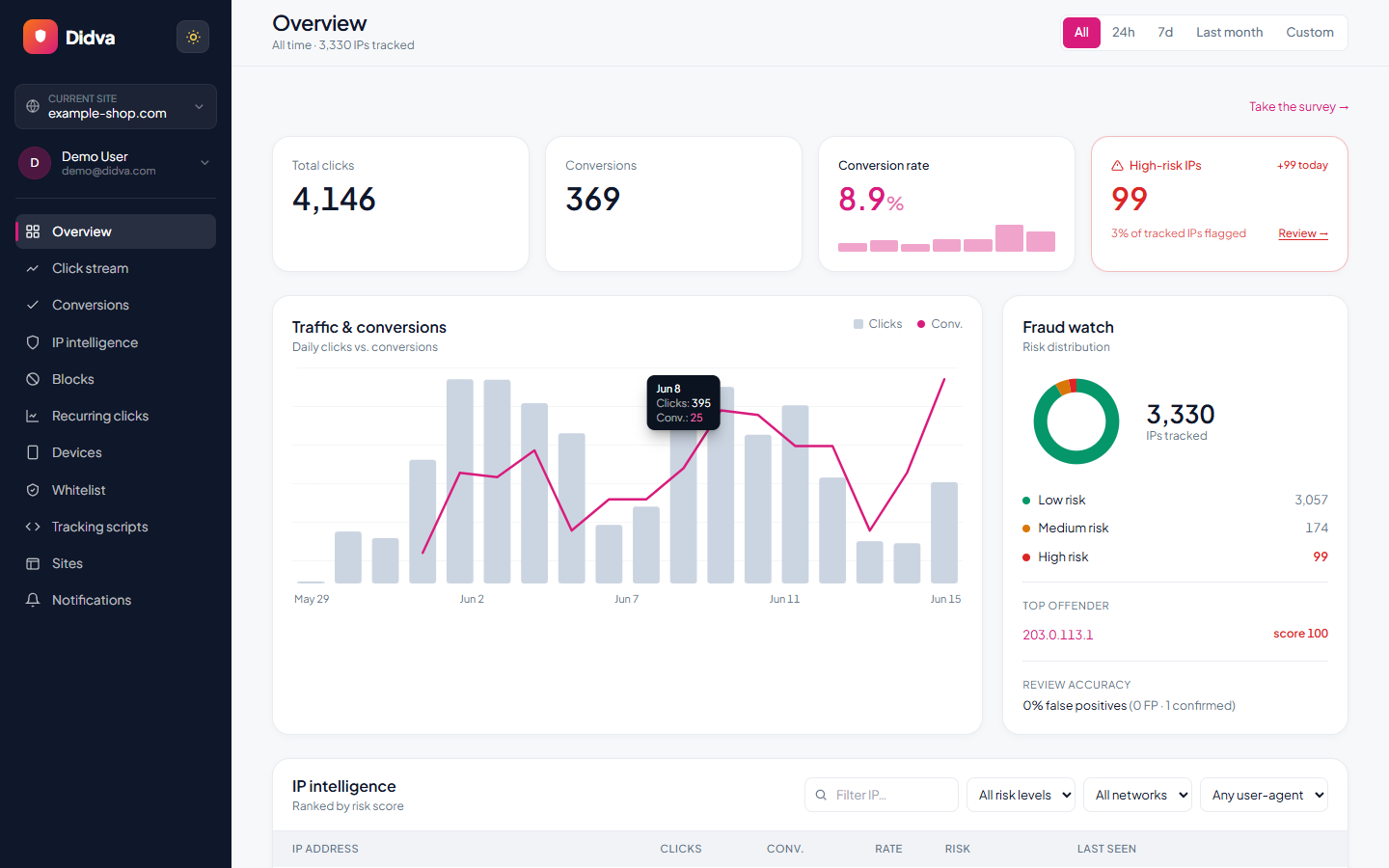
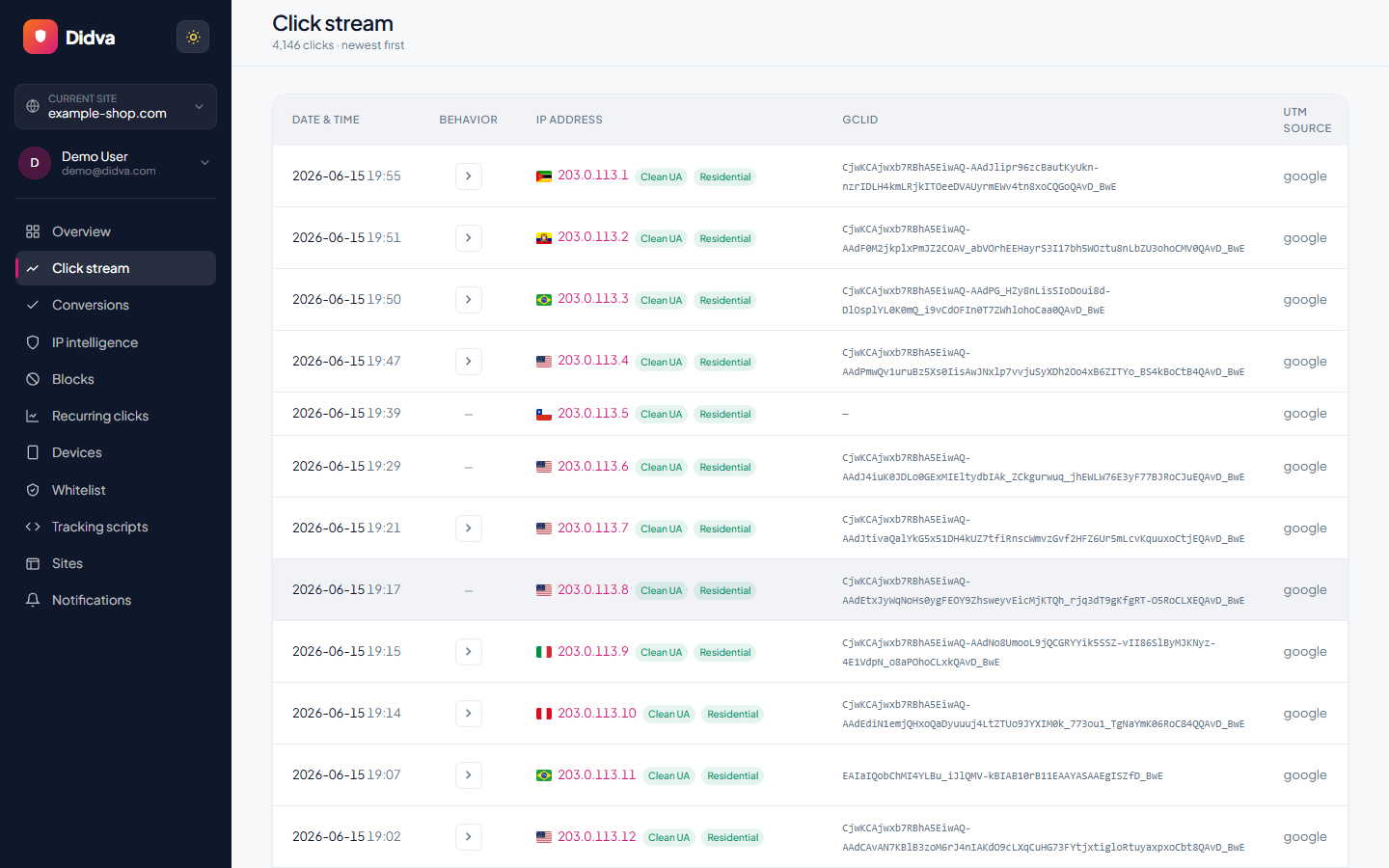
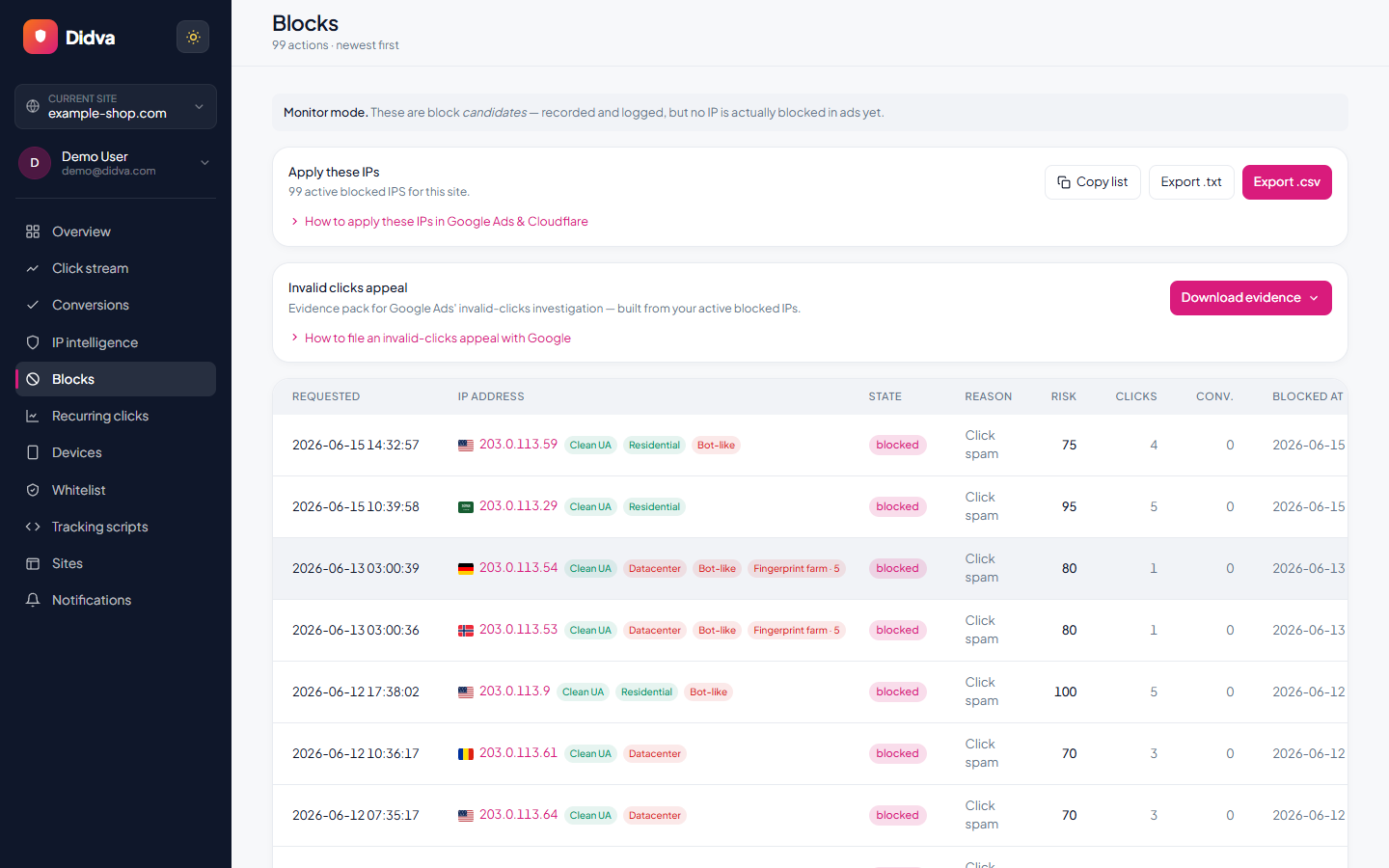
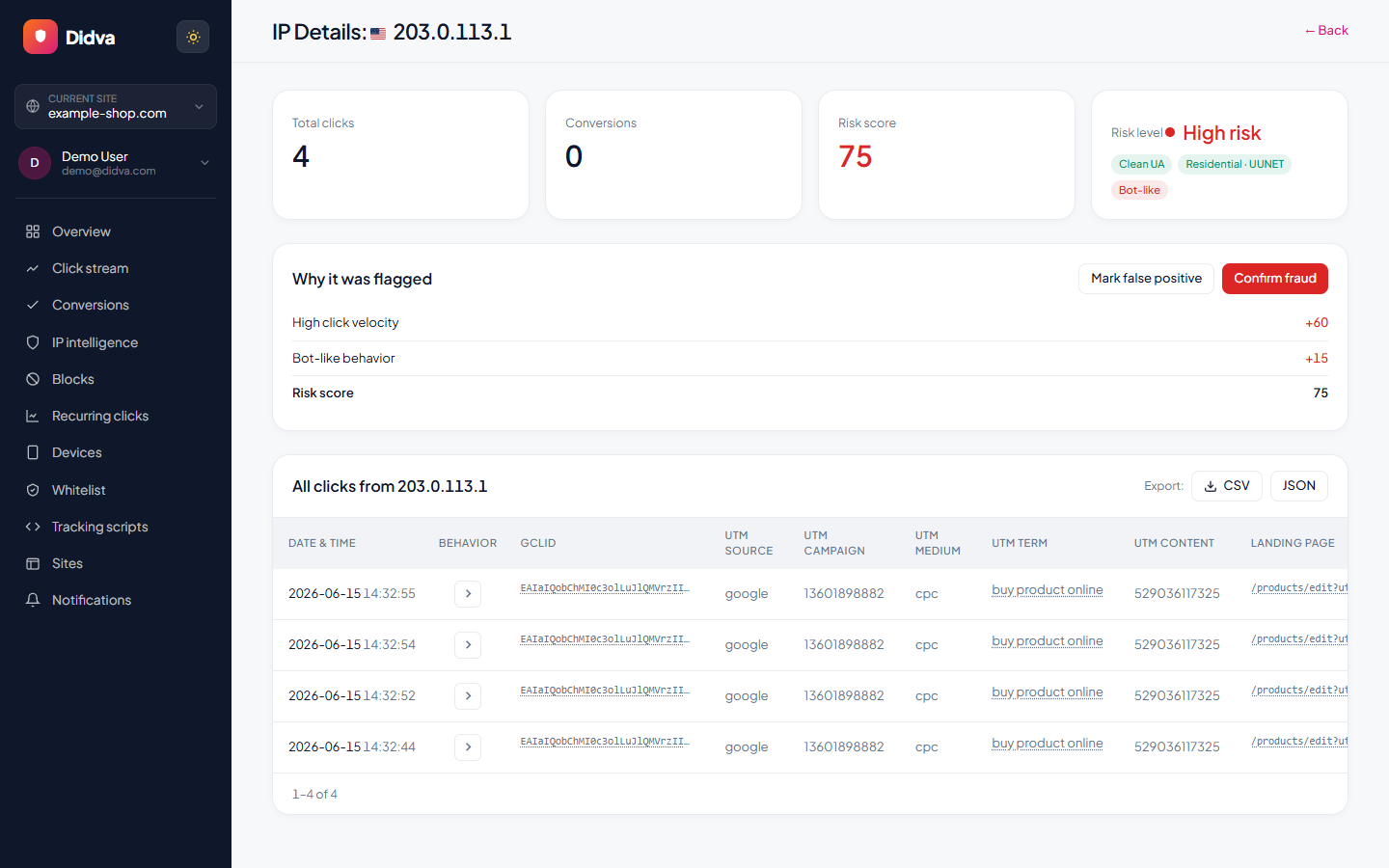
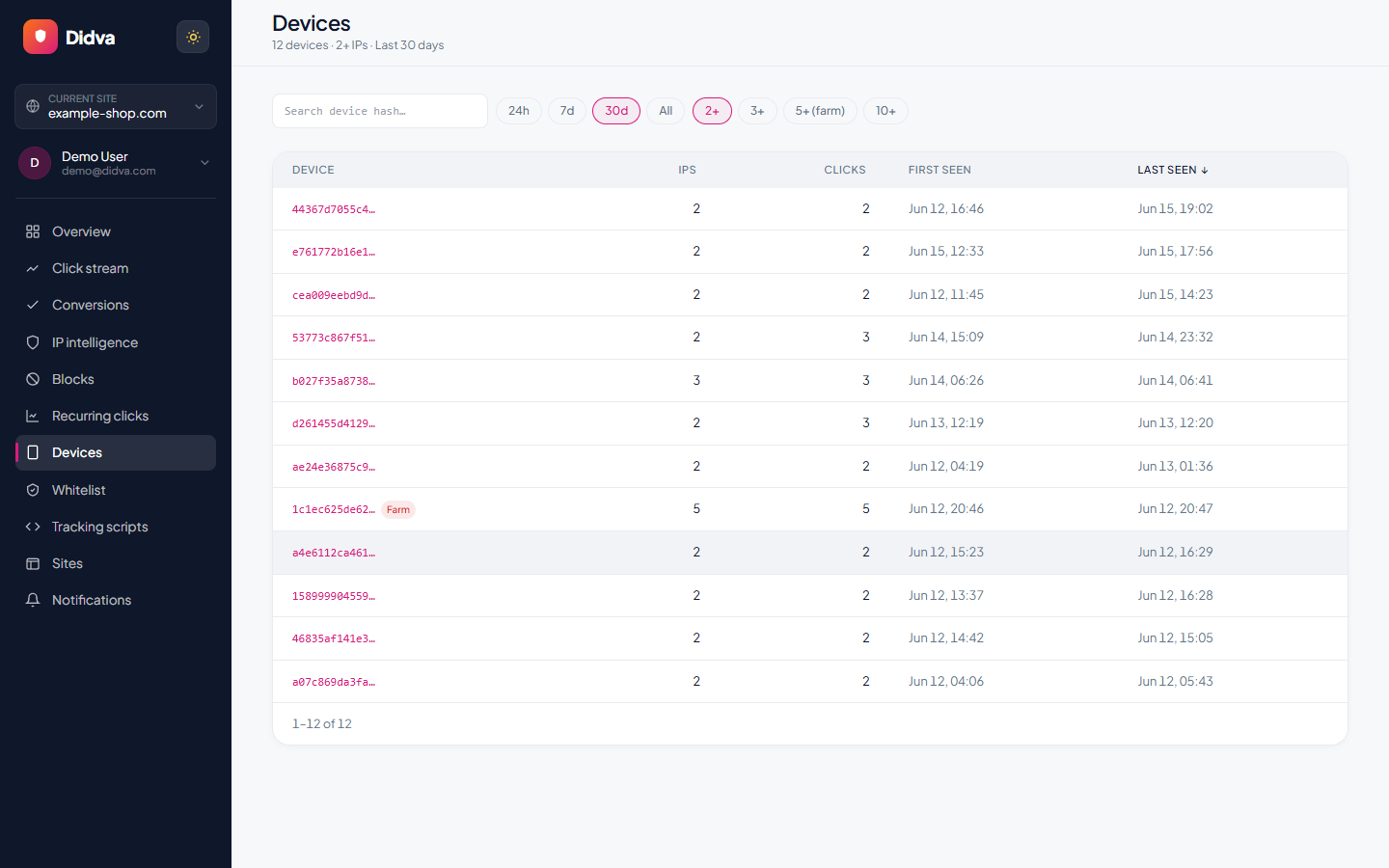
Demo account; IP addresses use the 203.0.113.x documentation range.
What advertisers say
Real feedback from teams protecting their paid traffic with Didva.
Caught a click-farm pattern our previous tool missed and cut wasted spend within the first month.
Setup was a single snippet. The evidence export made our Google Ads refund request painless.
Clear per-IP reasons and a review queue so we are not blocking real customers. Exactly what we needed.
Datacenter and repeat-click detection paid for itself fast. Reporting is clear enough to share with clients.
We manage campaigns across several clients and the dashboard quickly highlighted traffic patterns we would have otherwise missed.
Simple setup, useful alerts, and enough detail to investigate suspicious visitors without involving developers.
The product delivered value quickly. I would like a few more filtering options, but the core detection features work well.
The manual review queue helped us avoid blocking legitimate visitors while still dealing with suspicious traffic.
The IP-level evidence makes client conversations much easier. Instead of assumptions, we can show actual data.
One of the cleaner interfaces we have used in the ad fraud space. Reports are easy to understand.
Within the first week we found a source of repeated clicks that had been consuming budget for months.
Useful notifications, clear reasoning, and very little noise. Most flagged visits deserved attention.
We mainly wanted better visibility into traffic quality. The platform delivered exactly that.
I like that every flag includes supporting details. It builds confidence in the decisions being made.
We tested several tools and this was the easiest one to explain to both clients and team members.
Good balance between automation and transparency. Nothing feels hidden behind a black box.
The repeat-click reports helped us identify unusual traffic spikes during a competitor campaign launch.
Client reporting became much easier once we started including the exported traffic quality reports.
Strong product overall. A few advanced reporting features would be nice, but detection accuracy has been solid.
The value was obvious after the first couple of weeks. We now review suspicious traffic as part of our regular workflow.
Ready to see which clicks are real? Start protecting your paid traffic in minutes.
Start Protecting Your AdsFrequently asked questions
How much does Lunio cost?
Lunio doesn't publish a price. Its pricing page says the cost "is based on a small fraction of your ad spend" and asks you to fill in a form for a quote. Its global terms say fees are in GBP and billed annually in advance unless your order form says otherwise.
Does Lunio have a free trial?
Not a self-serve one. Lunio offers a 14-day free traffic audit, which you start by booking a demo. Didva, by comparison, has a free plan you can sign up for yourself with no card.
What is the cheapest alternative to Lunio?
Didva has a free plan for up to 3,000 clicks a month, and its first paid plan is $39 a month. Among paid-only tools, Clixtell's detection plan starts at $15 a month but only blocks from $50, and Fraud Blocker starts at $79 a month.
Is Lunio the same company as PPC Protect?
Yes. Lunio describes itself as "formerly PPC Protect", and ppcprotect.com now redirects to lunio.ai. Reviews and articles under either name describe the same company, but older PPC Protect pricing no longer applies.
Can I cancel Lunio at any time?
Under Lunio's default global terms, a subscription runs for 12 months and renews for another 12 unless you give written notice at least 90 days before the end of the term. Your own order form can set different terms, so check it before you plan a switch.
Which Lunio alternative covers TikTok and LinkedIn?
Of the tools on this page, only Lunio lists TikTok, LinkedIn, X and Reddit alongside Google, Microsoft and Meta. Spider AF also lists TikTok, and so does ClickPatrol, which isn't in the table. If those channels carry real budget for you, that is a good reason to stay with Lunio.
Does Didva block clicks on Microsoft Ads?
Not automatically. Didva identifies and scores Microsoft Ads clicks, and on paid plans you can download a paste-ready exclusion list for Microsoft Ads, which allows up to 100 IP addresses per campaign. Automatic blocking works in Google Ads and through Cloudflare.
Lunio vs ClickCease: which fits better?
Lunio's own answer, published on 23 October 2026, is that Lunio suits in-house teams spending $1M or more a year across ten or more channels, and ClickCease suits smaller self-serve advertisers on Google, Meta and Microsoft. ClickCease publishes prices from $99 a month; Lunio quotes after a demo. If your spend is mostly Google Ads and well below that level, Didva is a third option with a free plan.
How does Didva compare with Lunio?
Didva is narrower and cheaper. It blocks automatically in Google Ads and through Cloudflare, scores Microsoft and Meta clicks, and costs nothing on the free plan or $39 a month on Starter, billed monthly. Lunio covers TikTok, LinkedIn, X, Reddit and more, quotes a share of ad spend, and defaults to a 12-month contract.
Can I run Didva alongside Lunio?
Yes. A new Didva site detects and scores clicks but writes nothing to your ad accounts until you switch on Auto-block, so Lunio keeps protecting the account while you compare. When you do switch it on, Didva leaves the exclusions Lunio wrote in place and only fills the free slots.
What is Lunio's free traffic audit?
Lunio offers 14 days of its analytics on your traffic, free, which you start by booking a demo. Its comparison page says current ClickCease customers can run the audit next to their existing tool, then get a migration plan covering data retention, timing and existing exclusions.
Is Didva affiliated with Lunio?
No, we're a separate company. Every Lunio fact on this page links to the Lunio page we read it on, so you can check it.
Sources
- Lunio: "Lunio (formerly PPC Protect)", Series A announcement (Sept 2022)
- Google Ads Help: IP exclusions (500 per campaign, account-level list)
- Lunio pricing (checked 26 Oct 2026)
- Lunio global terms: 12-month term, 90-day notice, billed annually
- Lunio: "Lunio vs ClickCease" (23 Oct 2026): 14-day parallel audit, migration plan, $1M+ best fit
- ClickCease pricing (checked 9 Nov 2026)
- ClickCease FAQ: trial, cancellation, CHEQ ownership (checked 9 Nov 2026)
- ClickGUARD pricing (checked 30 Sep 2026)
- ClickGUARD platforms and formats
- Fraud Blocker pricing (checked 30 Sep 2026)
- Fraud Blocker plan pricing help article
- TrafficGuard pricing (checked 30 Sep 2026)
- TrafficGuard for Meta: supported campaign types
- Spider AF pricing (checked 30 Sep 2026)
- Spider AF platform integrations notice
Didva is an independent product and is not affiliated with, endorsed by, or sponsored by Lunio, PPC Protect or any other vendor named here. All product names and trademarks belong to their owners. Competitor prices, trials, contract terms and platform coverage were read on each vendor's own website on 30 September 2026, and Lunio's and ClickCease's pages were re-read on 26 October 2026. They can change; confirm them with the vendor before you decide.
See how much of your traffic is real
Tell us your site and we'll show you where invalid clicks are draining your budget.
Related solutions
See your own invalid clicks before you sign a contract.
Start on the free plan. It runs on your real traffic for as long as you like, with no card and no sales call.