TrafficGuard Alternative: Price, Coverage and When Not to Switch (2026)
TrafficGuard is strong on app installs, affiliates and Meta. If you mostly run Google Ads and want a price that doesn't depend on your spend, here is how Didva compares.
✓ Free plan with no card · Paid plans from $39/month · Monthly billing
Last updated · Reviewed by the Didva team
A TrafficGuard alternative makes sense when your ads run mainly on Google and you want a fixed price. TrafficGuard's published plan, Shield, costs $49 a month and covers Google Search on one website up to $30,000 a month in ad spend. Performance Max, Meta, mobile app installs and anything above that spend are sold as custom plans. TrafficGuard no longer lists a free plan, and its 30-day trial needs a card and only detects.
Don't switch if app install fraud is part of your problem. TrafficGuard works with AppsFlyer, Adjust, Kochava and TUNE, and Didva does nothing in that area. For a Google Search account, Didva is cheaper ($39 a month, with a free plan below that) and its price stays the same as your spend grows. Neither tool pushes exclusions into Microsoft Ads automatically.
Didva vs TrafficGuard at a glance
Competitor details from public pages, as of September 2026. Confirm current terms with the vendor.
| Feature | Didva | TrafficGuard | What this means for you |
|---|---|---|---|
| Entry price | $39/month | $49/month (Shield, marked a promo price) | Both publish an entry price. |
| What the entry plan covers | 20,000 clicks/month, Google Ads, up to 3 sites | Google Search, 1 website, up to $30k/month spend | TrafficGuard's limit is spend; Didva's is clicks. |
| Above the entry plan | Published tiers ($89, $249) | Custom quote (Scale) | Past $30k/month on TrafficGuard you negotiate a price. |
| Free plan | 3,000 clicks/month, no card, no end date | None listed | Didva lets you keep measuring for free. |
| Free trial | 14 days of Growth, no card | 30 days, card required, detection only | Neither charges during the trial. TrafficGuard takes a card up front and blocks nothing until you pay. |
| Performance Max | Not in Google Ads; Cloudflare can block the visit | On the Scale plan | Inside Google Ads, only TrafficGuard covers PMax. |
| Microsoft Ads | Scores clicks; paste-ready exclusion list (paid plans) | Not mentioned on TrafficGuard's pages | Neither pushes to Microsoft Ads automatically. |
| Meta | Tagged ad clicks; Cloudflare blocking on Growth | Audience exclusions, website-conversion campaigns only | TrafficGuard excludes inside Meta, on custom plans. Didva's route leaves the Meta click charged. |
| Mobile app install fraud | ✕ | AppsFlyer, Adjust, Kochava, TUNE | If you buy app installs, stay with TrafficGuard. |
| Contract | Monthly, cancel any time | Shield monthly, cancel any time; Scale terms agreed per plan | On Shield, switching is easy in both directions. |
- Watchtower Free
3,000 clicks/month · Detection, manual blocking, 7 days of data
- Starter $39 /mo
20,000 clicks/month · Automatic blocking, exports, daily reports
- Growth $89 /mo
100,000 clicks/month · Everything in Starter plus appeal packs
Monthly billing, cancel any time. New accounts get 14 days of Growth free, no card. Full pricing
Start free, no cardWhen TrafficGuard is the better choice
TrafficGuard covers kinds of fraud that Didva doesn't touch. On its Enterprise Mobile plan it checks app install and in-app events through AppsFlyer, Adjust, Kochava and TUNE, and in prevention mode it can reject invalid events before your attribution partner credits them. It also sells affiliate fraud protection. If you pay for installs or run an affiliate program, those are reasons to keep TrafficGuard, or to add it next to a search tool rather than replace it. Our guide to ad fraud detection software by fraud type lists the other tools in each of those areas.
It's also the better fit if Performance Max carries your budget, since its Scale plan protects PMax and Didva's campaign-level exclusions can't.
Where Didva costs less
For a Google Search account, the two entry plans do the same basic job: flag invalid clicks and add the sources to your Google Ads exclusion list. Didva's is $39 a month for up to 20,000 clicks and three sites. TrafficGuard's is $49 a month for one website, and only while your Google Search spend stays under $30,000 a month.
The difference grows with your account. At $31,000 a month in spend, TrafficGuard moves you to a custom Scale quote. Didva's price follows clicks, and its tiers are published: $89 a month for 100,000 clicks, $249 for 500,000.
TrafficGuard's pages don't mention Microsoft Ads; if Bing matters to you, our Microsoft Ads click fraud guide explains what you can block there yourself. There's also a free option. Didva's free plan tracks up to 3,000 clicks a month with no card and no end date. It detects and lets you block by hand, and it's a cheap way to see how much invalid traffic you really have before paying either company.
Trials compared
TrafficGuard's trial runs for 30 days, needs a card, and stays in detection mode the whole time, so it shows you fraud without stopping it. A new Didva account gets 14 days of the Growth plan without a card, blocking included, and then drops to the free plan unless you subscribe. To compare them, start both on the same day and check what each flagged by the end of week two.
How to switch from TrafficGuard
- Check which plan you're on. Shield is monthly with no long-term contract and can be canceled in your account settings. Scale terms are set in your custom plan.
- Export your exclusions. Save the IP exclusions TrafficGuard added to your Google Ads campaigns. Google allows 500 per campaign, so make room if the lists are nearly full.
- Keep TrafficGuard for what Didva doesn't cover. App install, affiliate and PMax protection won't move over. Decide whether to keep those parts before canceling.
- Overlap the two for Didva's 14-day trial, then subscribe to keep automatic blocking and cancel Shield.
- Export TrafficGuard's reports before access ends. Google looks at invalid activity from the past 60 days, no further back.
If TrafficGuard and Didva are both the wrong fit, the best click fraud software roundup compares ten tools, and our Lunio alternatives and CHEQ pages cover the other large vendors.
See Didva in action
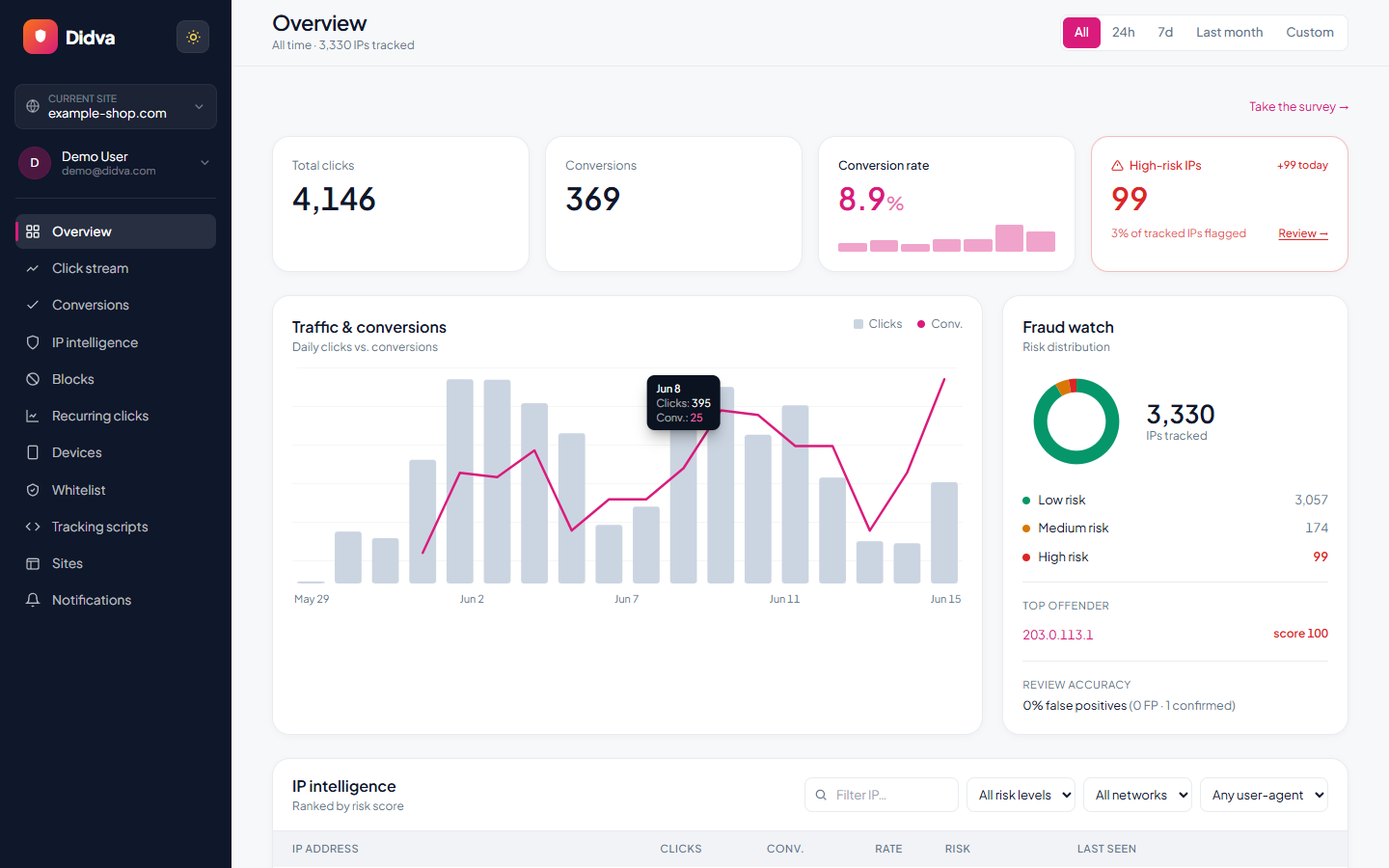
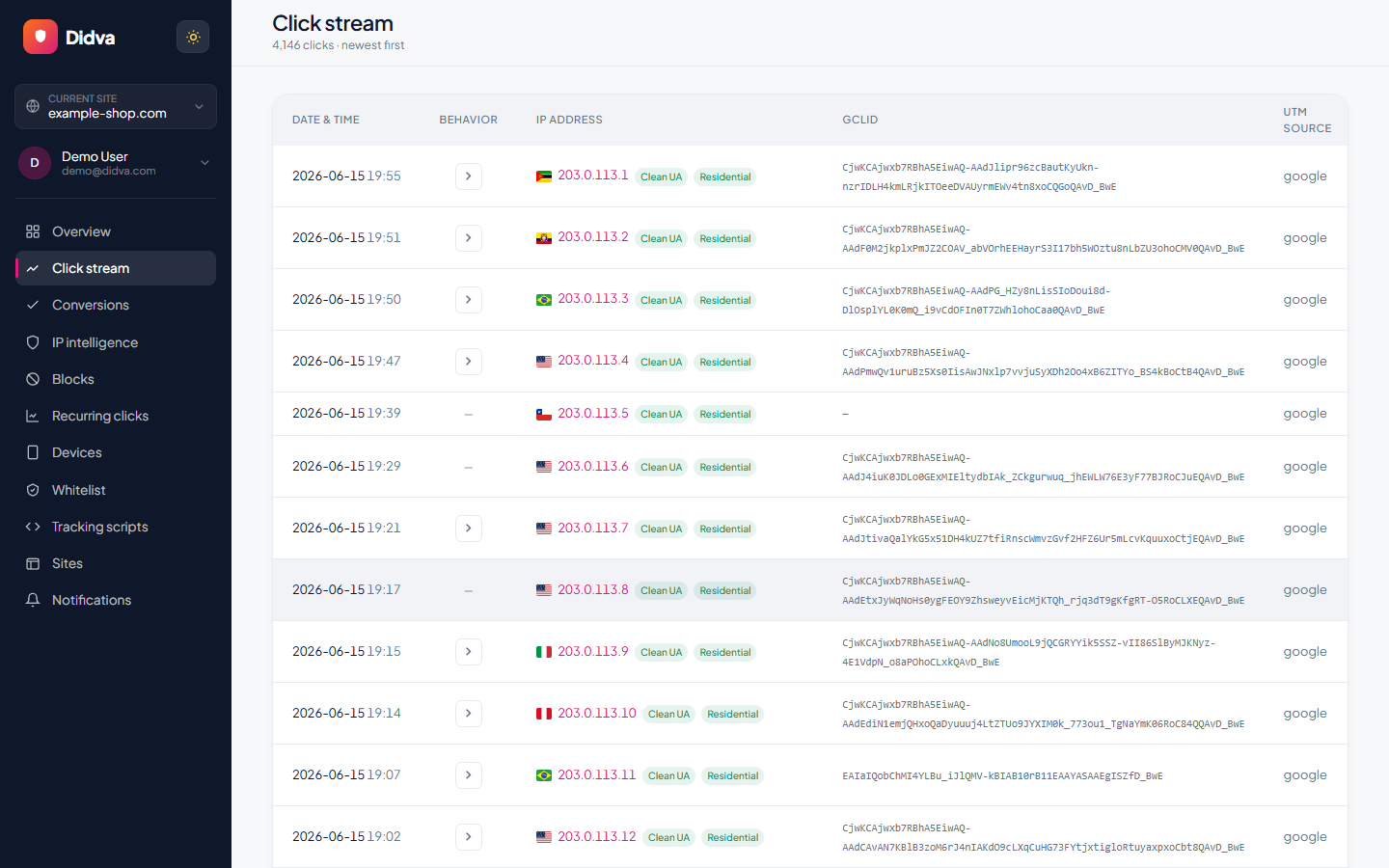
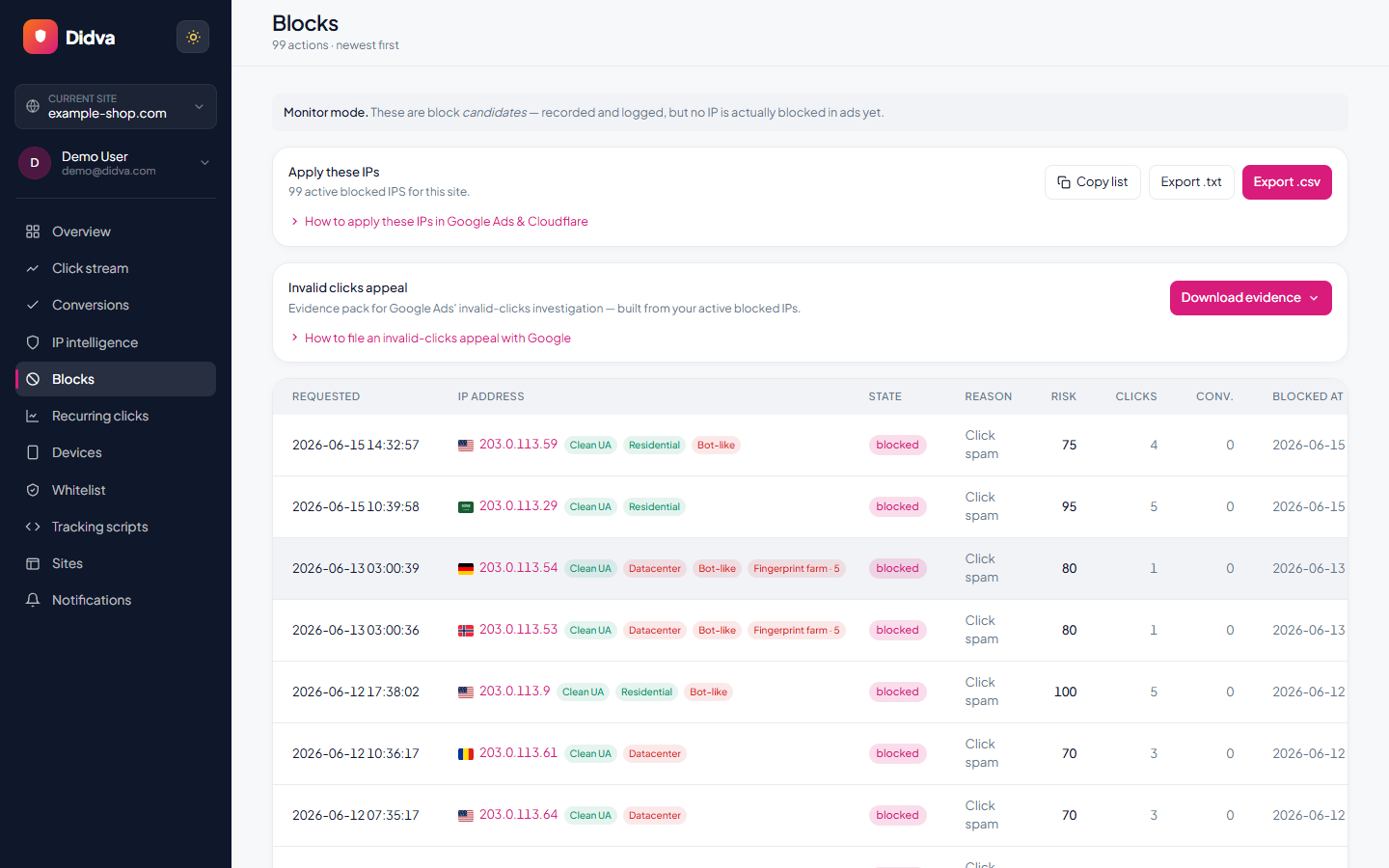
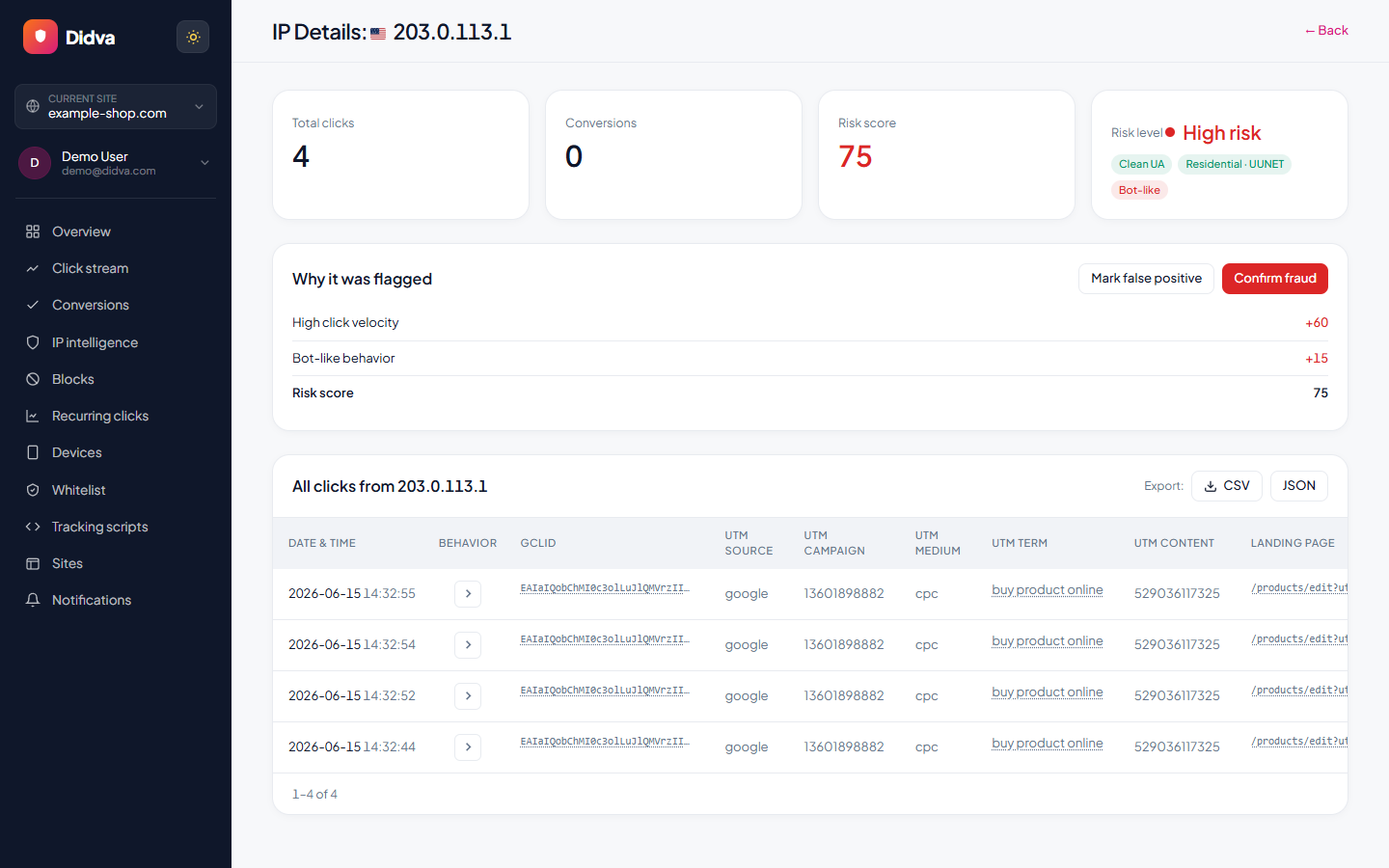
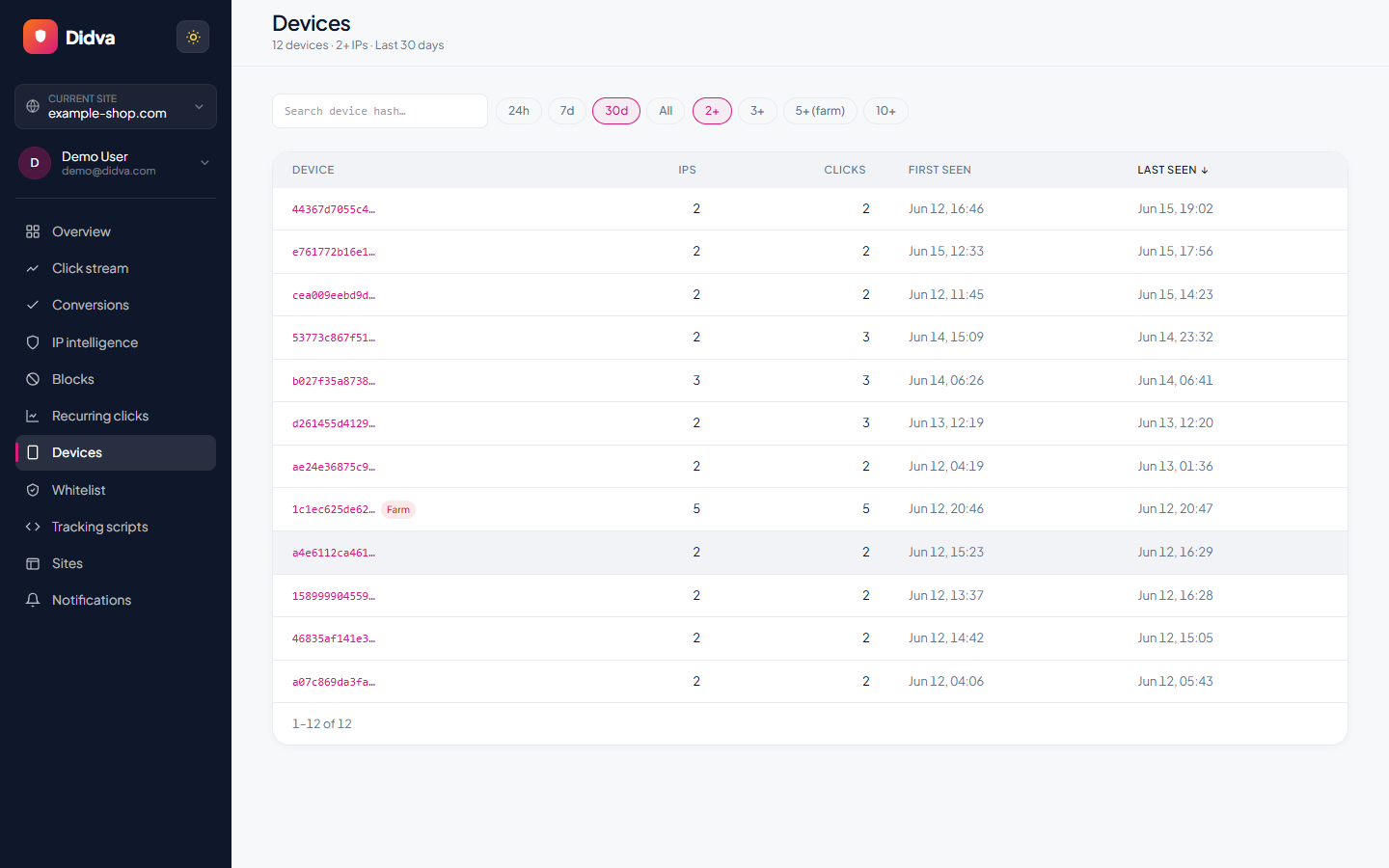
Real-time monitoring, risk scoring and one-click evidence, all in one dashboard.
What advertisers say
Real feedback from teams protecting their paid traffic with Didva.
Caught a click-farm pattern our previous tool missed and cut wasted spend within the first month.
Setup was a single snippet. The evidence export made our Google Ads refund request painless.
Clear per-IP reasons and a review queue so we are not blocking real customers. Exactly what we needed.
Datacenter and repeat-click detection paid for itself fast. Reporting is clear enough to share with clients.
We manage campaigns across several clients and the dashboard quickly highlighted traffic patterns we would have otherwise missed.
Simple setup, useful alerts, and enough detail to investigate suspicious visitors without involving developers.
The product delivered value quickly. I would like a few more filtering options, but the core detection features work well.
The manual review queue helped us avoid blocking legitimate visitors while still dealing with suspicious traffic.
The IP-level evidence makes client conversations much easier. Instead of assumptions, we can show actual data.
One of the cleaner interfaces we have used in the ad fraud space. Reports are easy to understand.
Within the first week we found a source of repeated clicks that had been consuming budget for months.
Useful notifications, clear reasoning, and very little noise. Most flagged visits deserved attention.
We mainly wanted better visibility into traffic quality. The platform delivered exactly that.
I like that every flag includes supporting details. It builds confidence in the decisions being made.
We tested several tools and this was the easiest one to explain to both clients and team members.
Good balance between automation and transparency. Nothing feels hidden behind a black box.
The repeat-click reports helped us identify unusual traffic spikes during a competitor campaign launch.
Client reporting became much easier once we started including the exported traffic quality reports.
Strong product overall. A few advanced reporting features would be nice, but detection accuracy has been solid.
The value was obvious after the first couple of weeks. We now review suspicious traffic as part of our regular workflow.
Ready to see which clicks are real? Start protecting your paid traffic in minutes.
Start Protecting Your AdsFrequently asked questions
How much does TrafficGuard cost?
TrafficGuard's Shield plan is $49 a month, labelled a limited promo price. It covers Google Search on one website for up to $30,000 a month in ad spend. Scale, Meta, affiliate and mobile plans are custom priced.
Does TrafficGuard have a free plan?
Not any more. TrafficGuard's pricing page lists Shield and custom plans only. There is a 30-day free trial, which needs a card and runs in detection mode, so nothing is blocked during it.
Does TrafficGuard support Microsoft Ads?
Microsoft Ads isn't mentioned on any TrafficGuard page we read on 30 September 2026. Ask TrafficGuard directly if Microsoft carries a real share of your budget.
Does TrafficGuard cover Performance Max?
Yes, on the Scale plan, which is custom priced. The $49 Shield plan covers Google Search only.
Does Didva protect Performance Max campaigns?
Not inside Google Ads. Didva writes IP exclusions at campaign level, and Google doesn't allow those on Performance Max campaigns. If you connect Cloudflare, Didva can still stop flagged visitors from reaching your site, whichever campaign sent them.
What is the best TrafficGuard alternative for mobile app installs?
Besides TrafficGuard itself, the attribution platforms have their own fraud filters: AppsFlyer, Adjust and Singular all sell install fraud protection. Click fraud tools for search ads, including Didva, don't handle install fraud.
TrafficGuard vs ClickCease, what's the difference?
ClickCease starts at $99 a month and blocks on Google and Meta on its published plans, and lists Microsoft support. TrafficGuard starts at $49 for Google Search and quotes everything else, and it sells affiliate and app install protection, which ClickCease's pages don't mention.
Is Didva affiliated with TrafficGuard?
No. Didva is a separate company and this is our own comparison. Every TrafficGuard fact links to the page we read it on.
Sources
- TrafficGuard pricing (Shield $49, $30k spend cap, 30-day trial, custom plans)
- TrafficGuard for Meta ("Awareness and App campaigns aren't supported")
- TrafficGuard mobile user acquisition (supported MMPs)
- TrafficGuard Google Search (IP exclusions, 12 months data retention)
- Google Ads Help: IP exclusions (not available on Performance Max campaigns)
- AppsFlyer fraud protection
- Singular fraud prevention
Didva is an independent product and is not affiliated with, endorsed by, or sponsored by TrafficGuard. All product names and trademarks belong to their owners. TrafficGuard prices, trial terms and coverage were read on TrafficGuard's own website on 30 September 2026 and can change; confirm them with TrafficGuard before you decide.
See how much of your traffic is real
Tell us your site and we'll show you where invalid clicks are draining your budget.
Related solutions
Keep one price as your Google Ads budget grows.
Start on the free plan, then move to $39 a month when you want automatic blocking.