Ad Fraud Detection Software: Tools by Fraud Type (2026)
Ad fraud isn't one problem, and no single product covers all of it. This guide maps each kind of fraud to the class of tool built for it, with named vendors.
✓ Free plan with no card · Paid plans from $39/month
Last updated · Reviewed by the Didva team
Ad fraud detection software finds traffic, clicks, installs or leads that come from bots or from people with no real interest, so you stop paying for them or stop counting them. The category splits into five kinds of tool: click fraud protection for search and social ads, verification for programmatic and TV buys, install fraud protection for mobile apps, form and lead protection, and affiliate fraud tools. Most buyers need one or two, not all five.
Pick the class that matches where your money goes. If you buy Google, Microsoft or Meta ads yourself, you want click fraud protection. If you buy programmatic display, video or connected TV, you want an MRC-accredited verification vendor. If you pay for app installs, use your attribution platform's fraud tools. Didva sits only in the first group.
Which tool covers which fraud
| Fraud type | Where it happens | Class of tool | Examples |
|---|---|---|---|
| Bot and repeat clicks on search and social ads | Google, Microsoft, Meta campaigns you run | Click fraud protection | Didva, ClickCease, ClickGUARD, Fraud Blocker, Lunio |
| Fake impressions, spoofed sites and apps, ad stacking | Programmatic display, video, CTV | Ad verification | DoubleVerify, Integral Ad Science, Pixalate, HUMAN |
| Fake installs, click injection, stolen attribution | Mobile app campaigns | Install fraud protection | AppsFlyer, Adjust, Singular, TrafficGuard |
| Fake form fills and bot sign-ups | Your website's forms | Lead and bot protection | Anura, CHEQ Form Guard, HUMAN |
| Fake referrals and hijacked clicks | Affiliate programs | Affiliate fraud tools | Spider AF, TrafficGuard, Anura |
| Paid humans clicking on real phones | Any of the above | Pattern detection within each class | See click farm detection |
The classes overlap at the edges. TrafficGuard sells click, app and affiliate protection. CHEQ sells click protection and form protection. Lunio covers click fraud across more ad channels than most. HUMAN works in verification and on-site bot defence. Start from where your money goes.
Click fraud protection for search and social ads
These tools watch clicks on campaigns you manage yourself in Google Ads, Microsoft Advertising or Meta, flag the invalid ones, and exclude the sources, usually as IP exclusions or excluded audiences inside the ad account. They're sold self-serve, mostly with published monthly prices, to businesses and agencies. Our roundup of click fraud software compares ten of them on price and platform coverage, and the click fraud detection software page covers how detection itself works.
Verification for programmatic and TV
If you buy display, video or connected TV through programmatic exchanges, the fraud is mostly in impressions: bots loading pages, apps pretending to be other apps, ads stacked where nobody sees them. Verification vendors measure this across the supply chain and are the ones with MRC accreditation. DoubleVerify says it is accredited for invalid traffic detection across desktop, mobile web, mobile apps and CTV. Pixalate and Integral Ad Science both announce MRC accreditation for sophisticated invalid traffic. These products are aimed at large media buyers and publishers, and they're priced accordingly.
Install fraud protection for mobile apps
Install fraud targets the attribution step: a fake click fired just before a real install so the fraudster gets paid for it, or installs from device farms and emulators. The attribution platforms are best placed to catch it because they see the click and the install together. AppsFlyer, Adjust and Singular all sell fraud protection inside their attribution products. Adjust, for example, filters "click injection", which it describes as a fake ad engagement sent between a download and the user's first session.
Lead, bot and affiliate fraud
Some fraud doesn't show up as a click at all. Bots fill in forms, fake users sign up, and affiliates send traffic they didn't really generate. Anura says it detects both GIVT and SIVT in real time to stop fake leads. CHEQ's Form Guard protects forms from bots and fake users. For affiliate programs, Spider AF and TrafficGuard both sell dedicated products. If your cost per lead looks fine but sales says the leads are junk, this is the class to look at; our fake lead prevention page goes further.
What MRC accreditation and TAG certification mean
The Media Rating Council audits measurement services. Accreditation follows an audit by independent CPA auditors, a review by an MRC audit committee and a board decision, and it has to be renewed every year. Its invalid traffic standard splits fraud into two tiers. General invalid traffic is what routine filtering catches with lists and standard checks, such as known data centers and declared bots. Sophisticated invalid traffic needs advanced analytics or human review, and covers hijacked devices, spoofed domains and apps, and "incentivized human invalid activity", with click farms given as an example.
MRC's current list shows SIVT detection accreditation for DoubleVerify, HUMAN, Integral Ad Science, Pixalate and Protected Media, and for Google Ads and Display & Video 360. None of the self-serve click fraud tools is on it, and we'd be wary of any that implies otherwise. TrafficGuard, for instance, describes its detection as "built to MRC guidelines", which is not the same as accreditation.
TAG Certified Against Fraud is a different thing: a program from the Trustworthy Accountability Group, started in 2016, that certifies companies in the ad supply chain for following anti-fraud practices, such as having all monetizable transactions filtered for invalid traffic by a qualified third party. Anura displays the seal.
Where Didva fits, and where it doesn't
Didva is a click fraud tool (plans and platform coverage are on our PPC fraud protection page). It records paid visits to your site, scores them each night, finds addresses that keep coming back, and on paid plans adds exclusions to your Google Ads campaigns automatically. For Microsoft Ads it gives you a paste-ready exclusion list (see the Microsoft Ads click fraud guide), and with Cloudflare connected it can turn flagged visitors away at your website. It isn't MRC accredited and doesn't verify programmatic impressions, app installs, affiliate traffic or form submissions. If your fraud problem sits in one of those areas, one of the tools above will serve you better.
One snippet. No code changes.
Paste the Didva tag on your paid landing pages and it starts scoring clicks straight away.
<script async src="https://app.didva.com/js/ct-click.js" data-site-key="YOUR_SITE_KEY"></script>
Replace YOUR_SITE_KEY
with the key from your dashboard. Add the conversion tag to thank-you pages to keep lead quality clean.
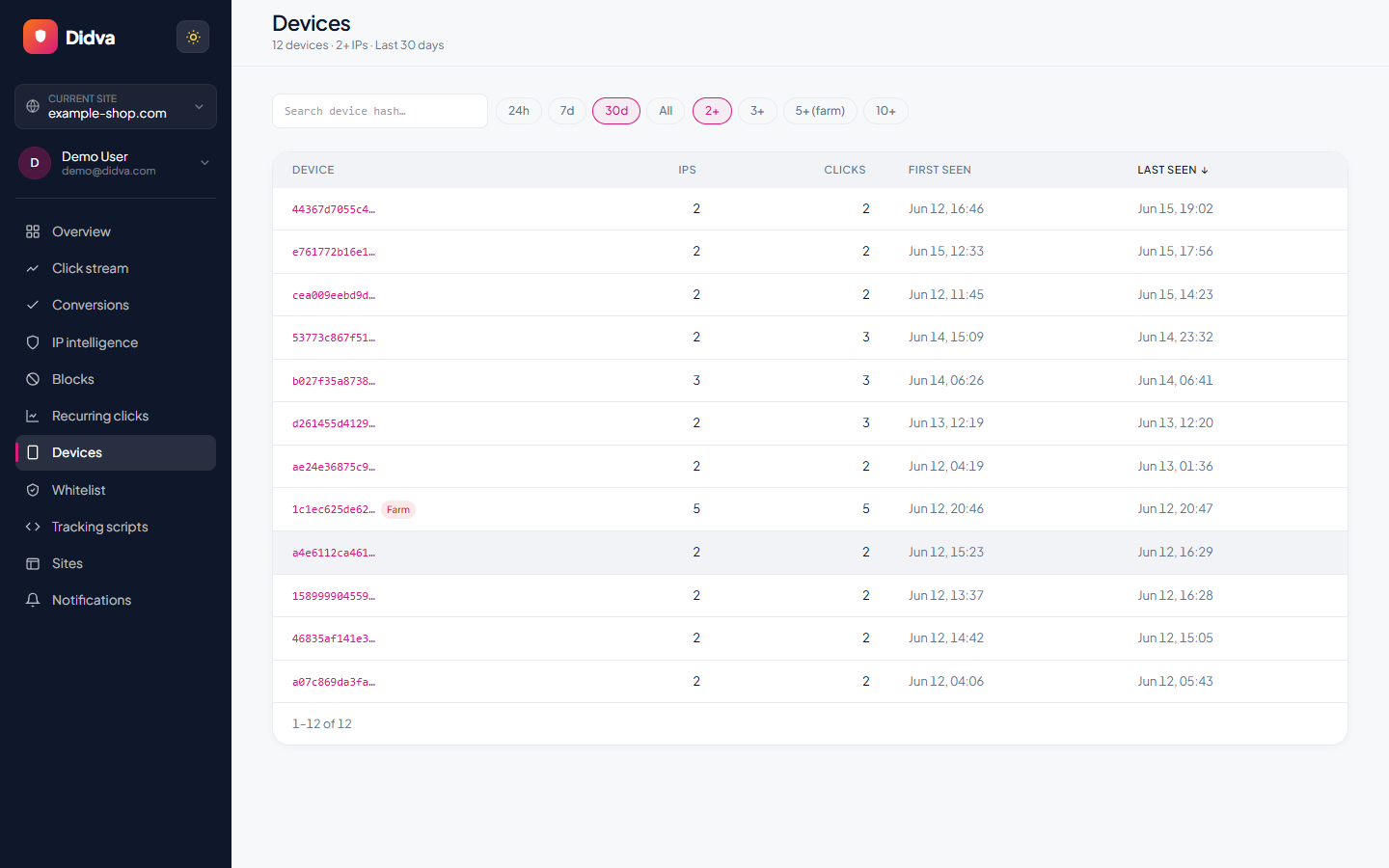
See Didva in action
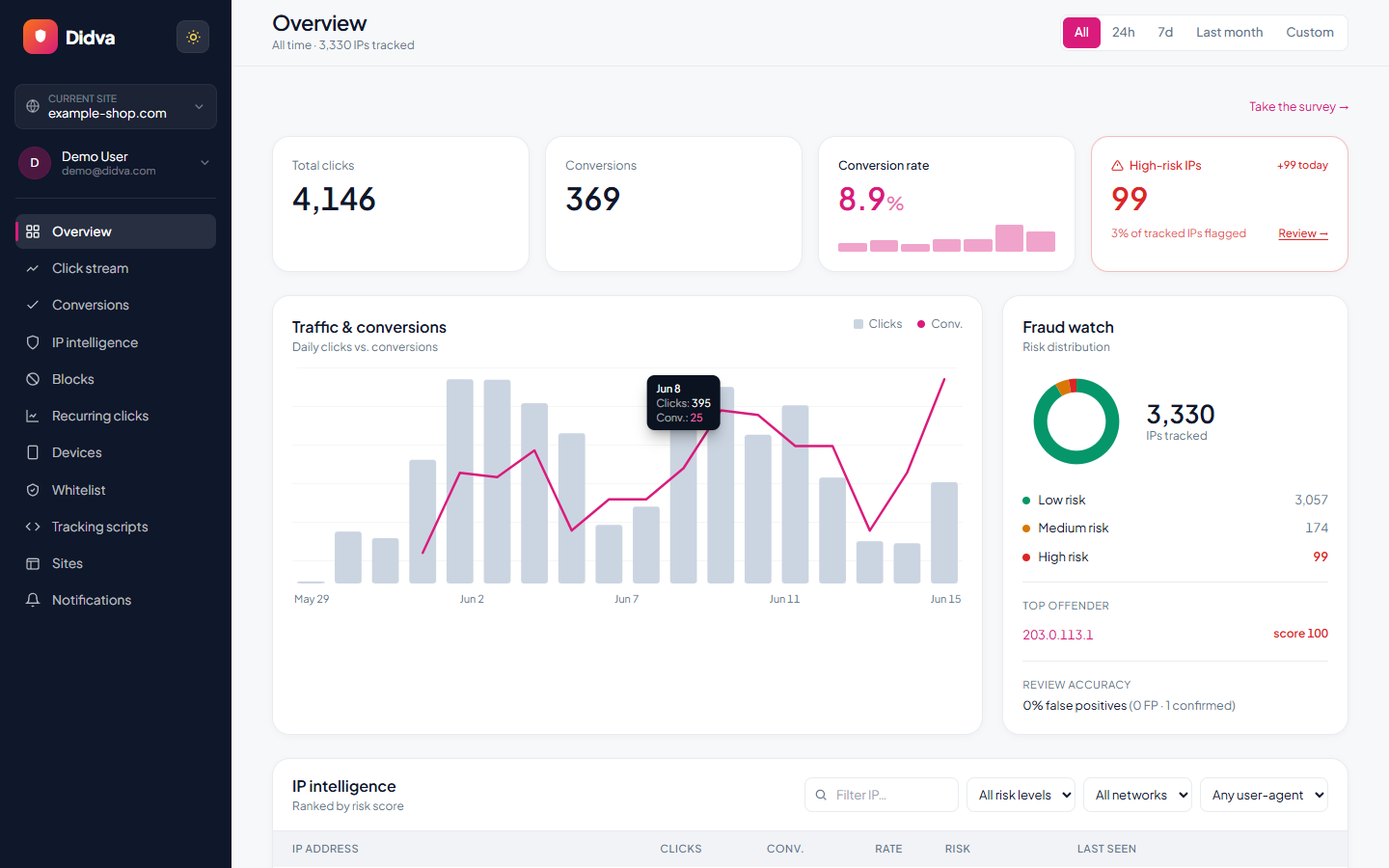
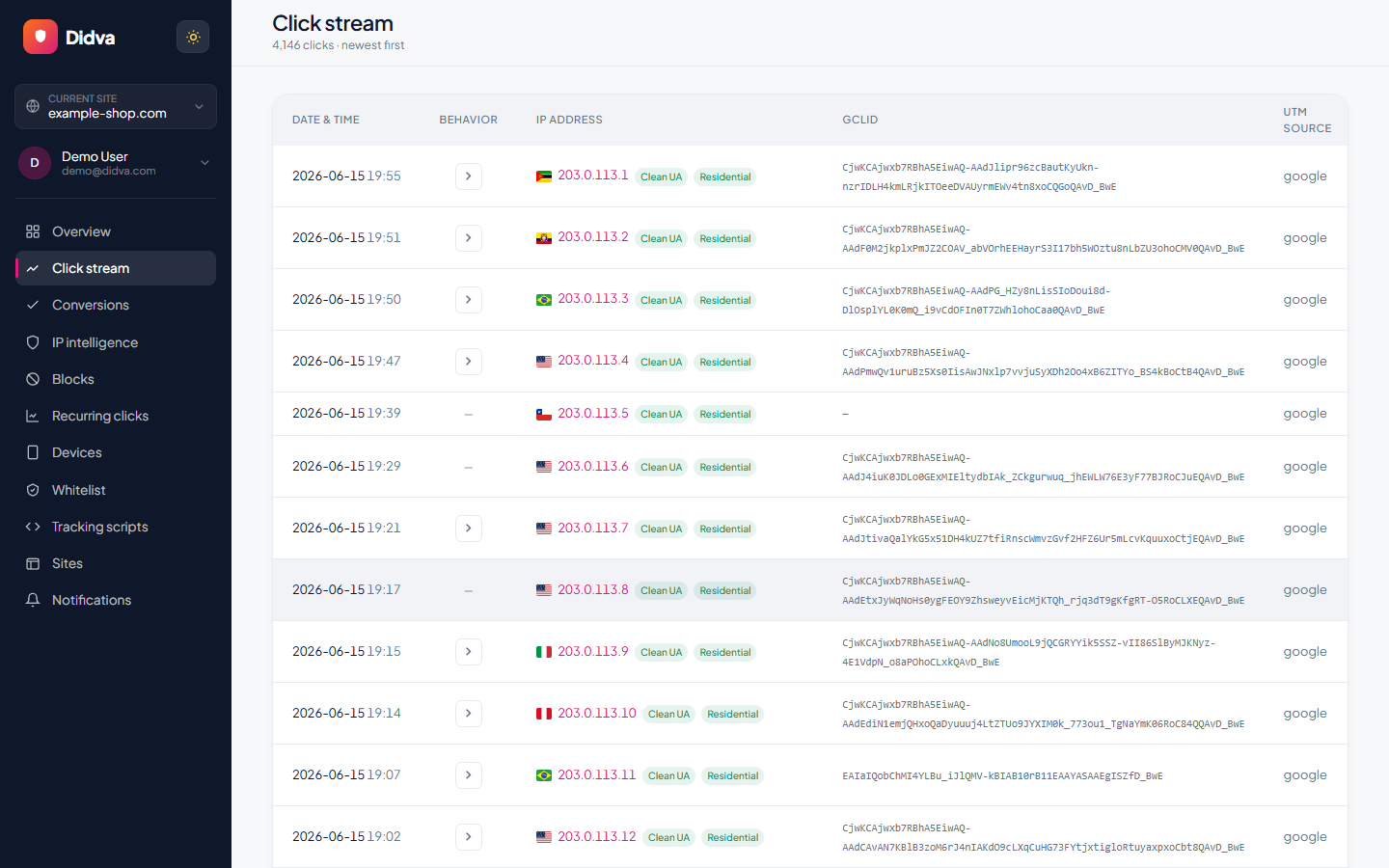
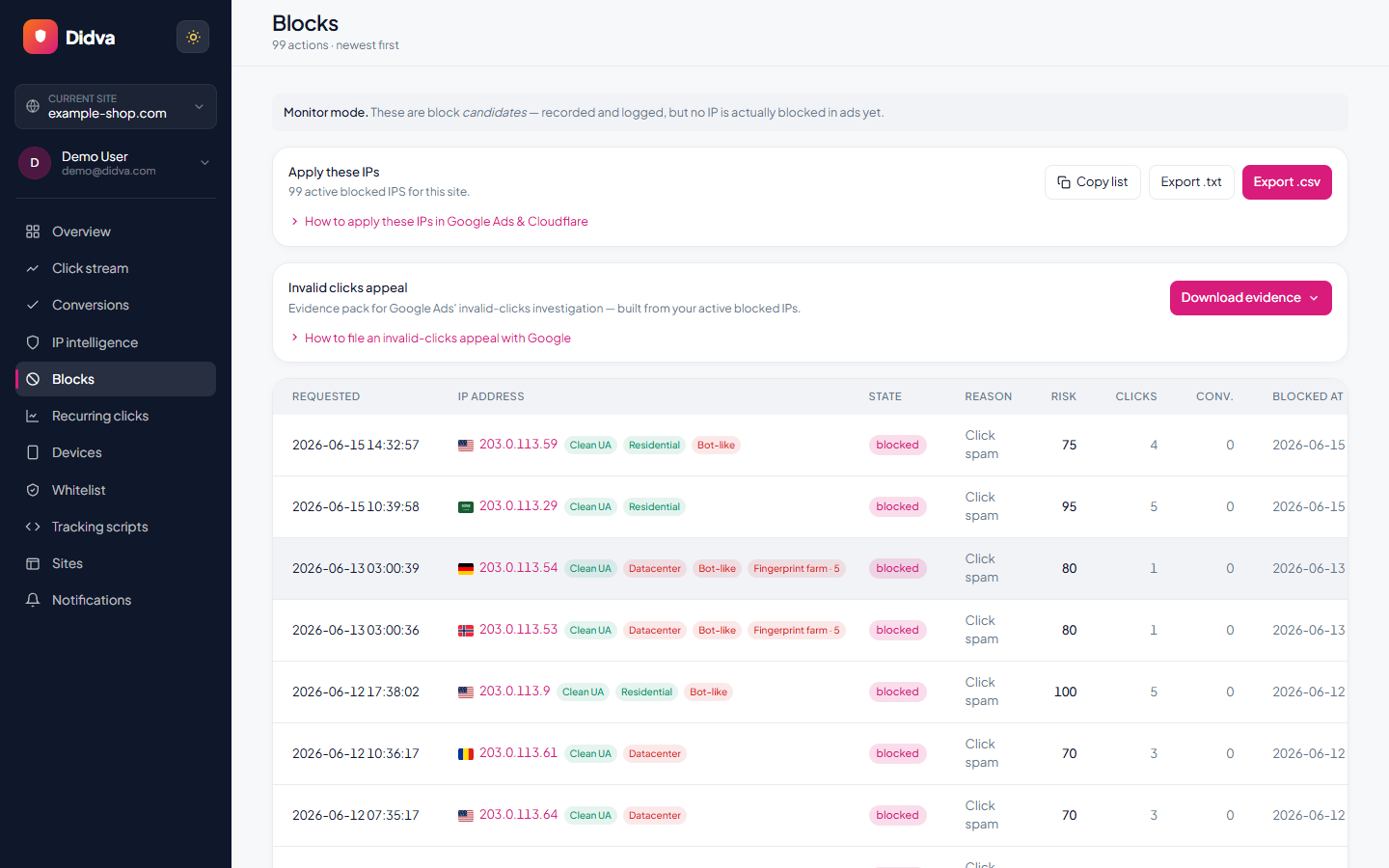
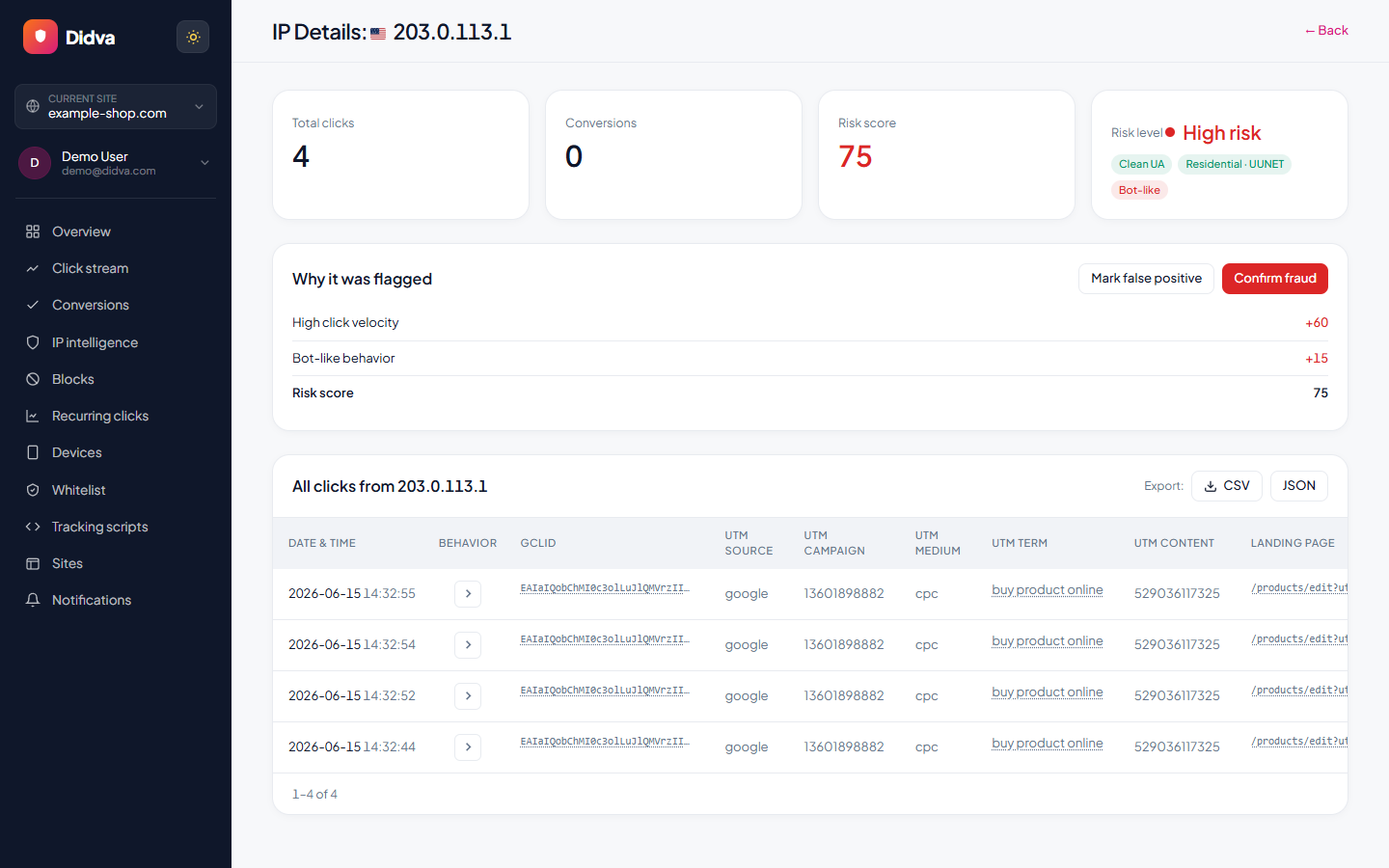
Real-time monitoring, risk scoring and one-click evidence, all in one dashboard.
What advertisers say
Real feedback from teams protecting their paid traffic with Didva.
Caught a click-farm pattern our previous tool missed and cut wasted spend within the first month.
Setup was a single snippet. The evidence export made our Google Ads refund request painless.
Clear per-IP reasons and a review queue so we are not blocking real customers. Exactly what we needed.
Datacenter and repeat-click detection paid for itself fast. Reporting is clear enough to share with clients.
We manage campaigns across several clients and the dashboard quickly highlighted traffic patterns we would have otherwise missed.
Simple setup, useful alerts, and enough detail to investigate suspicious visitors without involving developers.
The product delivered value quickly. I would like a few more filtering options, but the core detection features work well.
The manual review queue helped us avoid blocking legitimate visitors while still dealing with suspicious traffic.
The IP-level evidence makes client conversations much easier. Instead of assumptions, we can show actual data.
One of the cleaner interfaces we have used in the ad fraud space. Reports are easy to understand.
Within the first week we found a source of repeated clicks that had been consuming budget for months.
Useful notifications, clear reasoning, and very little noise. Most flagged visits deserved attention.
We mainly wanted better visibility into traffic quality. The platform delivered exactly that.
I like that every flag includes supporting details. It builds confidence in the decisions being made.
We tested several tools and this was the easiest one to explain to both clients and team members.
Good balance between automation and transparency. Nothing feels hidden behind a black box.
The repeat-click reports helped us identify unusual traffic spikes during a competitor campaign launch.
Client reporting became much easier once we started including the exported traffic quality reports.
Strong product overall. A few advanced reporting features would be nice, but detection accuracy has been solid.
The value was obvious after the first couple of weeks. We now review suspicious traffic as part of our regular workflow.
Ready to see which clicks are real? Start protecting your paid traffic in minutes.
Start Protecting Your AdsFrequently asked questions
What is ad fraud detection software?
Software that identifies invalid activity in advertising, such as bot clicks, fake impressions, fraudulent app installs or fake leads, so advertisers can block it, stop paying for it or remove it from their reports.
What is the difference between ad fraud and click fraud?
Click fraud is one kind of ad fraud, aimed at pay-per-click ads. Ad fraud also includes fake impressions and spoofed websites in programmatic buying, fake app installs, fake leads and affiliate fraud.
What does MRC accreditation mean?
The Media Rating Council audits ad measurement services. An accredited service has passed an audit by independent CPA auditors, reviewed by an MRC committee and board, and has to renew it every year. MRC publishes the list of accredited services and what each covers.
What are GIVT and SIVT?
General invalid traffic (GIVT) is found with routine filtering, such as lists of known data centers and declared bots. Sophisticated invalid traffic (SIVT) needs advanced analysis or human review to find, and includes hijacked devices, spoofed apps and sites, and paid human activity such as click farms.
Which ad fraud tools are MRC accredited for SIVT?
MRC's digital accreditation list shows sophisticated invalid traffic detection for DoubleVerify, HUMAN, Integral Ad Science, Pixalate and Protected Media, as well as Google Ads and Display & Video 360. Click fraud tools for search ads, Didva included, are not on it.
Do I need MRC-accredited software for Google Ads?
Not usually. Google's own ad traffic filtering is MRC accredited, and search click fraud tools work on top of it. MRC accreditation matters most when you buy programmatic media and need independent measurement to settle disputes with sellers.
Where does Didva fit?
Didva is a click fraud tool for advertisers running their own paid search campaigns, with limited Meta coverage. It scores paid visits on your site, adds exclusions automatically in Google Ads, gives Microsoft Ads users a paste-ready list, and can block visitors through Cloudflare. It doesn't verify programmatic impressions, app installs or affiliate traffic.
Sources
- MRC: accreditation (independent audits, annual renewal)
- MRC: audit and accreditation process (independent CPA auditors)
- MRC: accredited digital services (SIVT detection list)
- MRC IVT Guidelines Addendum, June 2020 (GIVT and SIVT definitions)
- TAG Certified Against Fraud program
- DoubleVerify: fraud and invalid traffic
- Pixalate: MRC SIVT accreditation across environments
- IAS: MRC SIVT accreditation for CTV
- AppsFlyer fraud protection
- Adjust: click injection filtering
- Anura: lead generation fraud
- Spider AF: affiliate fraud protection
See how much of your traffic is real
Tell us your site and we'll show you where invalid clicks are draining your budget.
Related solutions
Start with the fraud you're actually paying for.
If that's paid search clicks, Didva's free plan will show you how much of your traffic it flags.